
Continuous Fraud Prevention for Every Day Use and Evolving Threat Landscape
Fraud rarely announces itself clearly. In real life, it blends into everyday use: the same device, the same app, the same flows customers use daily. The difference is that behind the screen, attackers are constantly adapting by using stolen credentials, AI-generated video, and increasingly sophisticated deepfake techniques.
The real challenge for digital services today is not adding more checks. It’s maintaining trust during normal use, without turning everyday moments into interruptions.
At Candour, we focus on one simple idea: fraud prevention must work continuously, quietly, and adapt as threats evolve, without changing how customers naturally use their devices.
Why fraud keeps slipping through traditional checks
Many fraud prevention approaches are still built around fixed moments: login, onboarding, a single verification step. These moments matter but most serious fraud doesn’t happen there.
Attackers have learned to work around individual signals:
- Credentials can be stolen and reused at scale.
- AI-generated video and replay techniques are increasingly used to bypass camera-based checks.
- Stolen devices and coercion make “remote-only” risk signals unreliable, because the attacker is physically present.
Adding more visible steps can reduce risk, but it also adds friction. Over time, this creates a familiartrade-off: security versus usability. And in everyday use, that trade-off becomes expensive.
Everyday use needs continuous fraud prevention
Customers don’t think in terms of “security events”. They just use their phones to log in, to pay, to manage accounts. Fraud prevention needs to operate at the same rhythm.
This is why Candour focuses on continuous fraud prevention: assessing risk throughout normal interaction, not just at a single checkpoint. The goal is not to challenge users more often, but to understand whether what’s happening still looks like genuine, natural use.
Instead of asking “Does this check pass?”, the system asks:
“Does this interaction still make sense?”
“Does this interaction still make sense?”
Evolving fraud: deepfakes don’t stand still
Deepfakes and synthetic video attacks are not a one-time problem. They evolve continuously. What fooled systems last year may look crude today and what looks convincing now will be commoditised tomorrow.
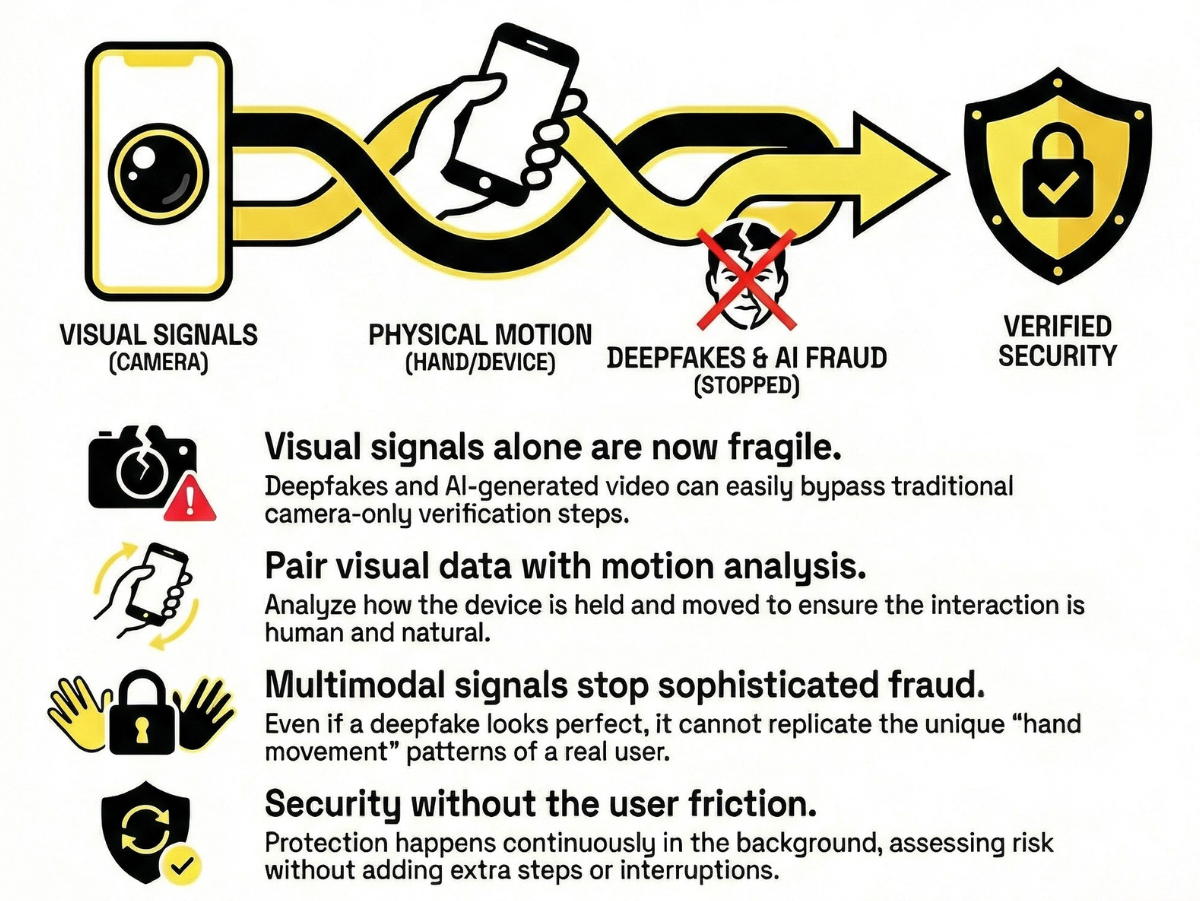
This is where relying on visual signals alone becomes fragile.
Camera-based checks focus on what is visible. But video can be injected, replayed, or generated without any real physical interaction. As deepfakes improve, visual realism becomes easier to fake often without increasing attacker effort.
To keep up, fraud prevention has to look beyond what the camera sees.
Multimodal signals without user friction
Candour’s approach combines multiple signal types that are difficult to fake together in real time without adding steps for the user.
In practice, this means pairing visual verification with motion analysis and device interaction signals. While the camera captures a face, the device itself tells another story: how it is held, moved, and interacted with.
This combination helps answer a more robust question:
- Does the video look real?
- And does the device use look natural at the same time?
When these signals don’t align, the risk becomes visible, even if the video alone appears convincing.
When the attacker is physically present
Some of the hardest fraud scenarios are surprisingly mundane. A phone is stolen. A user is pressured to unlock it. Everything looks “correct” on paper: the right device, the right credentials, the right face.
In these moments, location and network signals offer little help. What matters is how the interaction compares to the genuine user’s normal behaviour.
By analysing motion and interaction patterns, Candour can detect when device use no longer resembles the customer’s everyday behaviour and respond automatically, without forcing the user through extra steps.
This is continuous fraud prevention at work: quietly assessing risk while everyday use continues.
A simple way to think about it
A useful mental model is not more checks, but better alignment:
- A real person is present
- The face matches
- The device is being used naturally
When these elements align, use continues smoothly. When they don’t, the system has a clear signal that something has changed and even if everything looks fine on the surface.
Is your fraud prevention keeping up with everyday use?
As fraud evolves, it’s worth asking:
- Can we detect deepfake and replay attempts without increasing friction?
- Do we look beyond the camera, into real device use?
- Can we spot risk during normal interaction, not just at login?
- Do our defences evolve as attacks evolve?
If not, the gap between attackers and defenders will keep widening, quietly, in everyday moments.
Candour’s perspective
At Candour, we design fraud prevention for how people actually use their devices, continuously, naturally, and under real-world pressure.
By combining visual signals with motion and interaction intelligence, we help organisations stay ahead of evolving fraud techniques like deepfakes, without turning everyday use into a security process.
Fraud evolves. Protection needs to evolve with it, quietly, and continuously.